
Wabash County Arrest to Court Records
The Wabash County arrest-to-court path has several records. Jail booking creates a custody record at the Wabash County Jail. The prosecutor then reviews law-enforcement reports and decides whether to file formal criminal charges. Once charges are filed, the case appears in Wabash County Circuit or Superior Court records administered by the Clerk.
The Wabash County Prosecutor's Office represents the State of Indiana in felony and misdemeanor prosecutions for crimes committed in Wabash County. The prosecutor may file, amend, reduce, or dismiss charges. That is why jail booking charges should be compared with court records after a jail arrest before treating a charge as the final case status.
Arrest -> booking -> prosecutor review -> filed charge -> initial hearing -> bond or release order -> later case events.
Search Wabash County Court Records
The public online starting point is Indiana MyCase. The Indiana Judicial Branch Wabash County page links to MyCase for court case search and says case information and some documents are available there. MyCase terms also warn that online information is not the official court record and may contain errors or omissions. Official records come from the court that maintains the record.
- Search the jail roster first if custody status, booking date, or booking name is needed.
- Open MyCase and search by defendant name, case number, citation number, or other available field.
- Narrow to Wabash County where the filter is available.
- Open the criminal case and compare filed charges with jail booking charges.
- Check docket events such as initial hearing, bond hearing, pretrial conference, plea, trial, and sentencing.
- If the case or document is not online, contact the Wabash County Clerk for the official record.
Wabash County MyCase Search Fields
MyCase supports several search fields. A case number is strongest when it is known from bond papers, court notices, or counsel. Party name is the usual option when a person only has the defendant's name. For common names, use county, case type, date, or charge clues to avoid mixing separate people.
| Field Label | Type | Required | Notes |
|---|---|---|---|
| Case number | Text | Optional | Best when known from court or bond paperwork. |
| Citation number | Text | Optional | Useful for traffic or infraction matters. |
| Cross reference number | Text | Optional | Use when available from a notice or document. |
| Party name | Text | Optional | Search defendant name; exact spelling helps. |
| Attorney | Text | Optional | Used for attorney-linked searches. |
| Court / county filter | Dropdown/filter | Optional | Select Wabash County where available. |
Wabash County Clerk Records
The Wabash County Clerk administers official trial court records. The Clerk page says the office receives filings and processes new cases for civil, criminal, family, probate, and small claims matters. It also issues arrest warrants, commitments, protective orders, service of process, and writs.
Wabash County Clerk's Office
69 W Hill St, First Floor of Judicial Center
Wabash, IN 46992
(260) 563-0661 or (800) 286-3190
Fax: (260) 569-1352
Office hours: 8 am - 4 pm, Monday-Friday
Passport and marriage licenses: 8 am - 3:30 pm
Use the Clerk when an official copy is needed, when MyCase does not show the record, or when a document must be confirmed directly from the court file.
Wabash County Charging Records
Court records after a jail arrest often turn on the charging document. Indiana cases may use different labels depending on the case and procedure. The key point is that a charging document is the court-side record that states the formal accusation. It can differ from the jail's booking charge.
| Document | What It Means | Where It Fits |
|---|---|---|
| Complaint | A written allegation that begins or supports a criminal case. | May appear early in court processing. |
| Information | A prosecutor-filed charging document used in many felony and misdemeanor cases. | Shows the filed charge selected by the prosecutor. |
| Indictment | A grand-jury charging document. | Used when a grand jury returns charges. |
Wabash County Charge Status
Charge status matters because an arrest is not a conviction. A Wabash County jail arrest may lead to no filing, a pending charge, an amended charge, a dismissal, a plea, a trial, or a conviction. MyCase and Clerk records are the sources for these court outcomes.
| Status | Plain Meaning | Why It Matters |
|---|---|---|
| Pending | Filed and unresolved. | The case is still active. |
| Amended | Changed by prosecutor or court filing. | The filed charge may no longer match the booking charge. |
| Dismissed | Dropped by court or prosecutor order. | A dismissal is not the same as a conviction. |
| Reduced | Replaced by a lesser charge. | Sentencing and record meaning may change. |
| Disposition | Final outcome. | Shows how the court resolved the case. |
| Conviction | Finding or admission of guilt. | Different from arrest, booking, or pending charge. |
Wabash County Records Compared
Two comparisons prevent common mistakes. A charge is not a conviction, and a sealed record is not the same as an expunged record. Indiana record access can change when a court enters sealing or expungement relief, but users should confirm the order and its scope with the court or counsel.
| Comparison | First Term | Second Term |
|---|---|---|
| Charge vs conviction | A charge is an accusation filed or listed in a record. | A conviction is a final guilt finding or plea accepted by the court. |
| Sealed vs expunged | Sealed access is limited by court order. | Expungement is statutory relief that can restrict or alter public access depending on the order. |
For custody and booking status, use the Wabash County inmate records page. For booking photos, use the Wabash County jail mugshots page. Court records after arrest should be checked through MyCase and the Clerk.
Wabash County Bond and Warrants
Bond and warrant information may appear in both jail and court contexts. The jail roster may show a bond value or hold, while MyCase may show the court order, bond hearing, failure to appear, or warrant-related docket entry. Wabash-specific bond posting instructions, kiosk details, vendor names, and payment methods were not found on the sheriff site, so call the jail before attempting to post bond.
- Cash bond
- Payment required under a court or jail process.
- Surety bond
- Bond posted through a licensed bail agent if allowed by the court.
- No-bond hold
- A status where paying money does not permit release.
- Bench warrant
- A judge-issued warrant, often for failure to appear or violation of a court order.
Wabash County Prosecutor Role
The prosecutor's official site says the office handles felony and misdemeanor prosecutions, criminal investigations, grand jury proceedings, juvenile adjudications, traffic violations, victim assistance, and other duties. William C. Hartley, Jr. is identified as the elected prosecuting attorney. Prosecutor decisions explain why a court record after a jail arrest can look different from the booking record.
Wabash County Prosecutor's Office
93 W. Hill Street
Wabash, IN 46992
(260) 563-3982
Email: office@wabashprosatty.org
Hours: Monday-Friday, 8:00 a.m. - 4:00 p.m.
Wabash County Court Portal Sources
The Wabash County Clerk page links users to MyCase and gives local court-record office contact details.
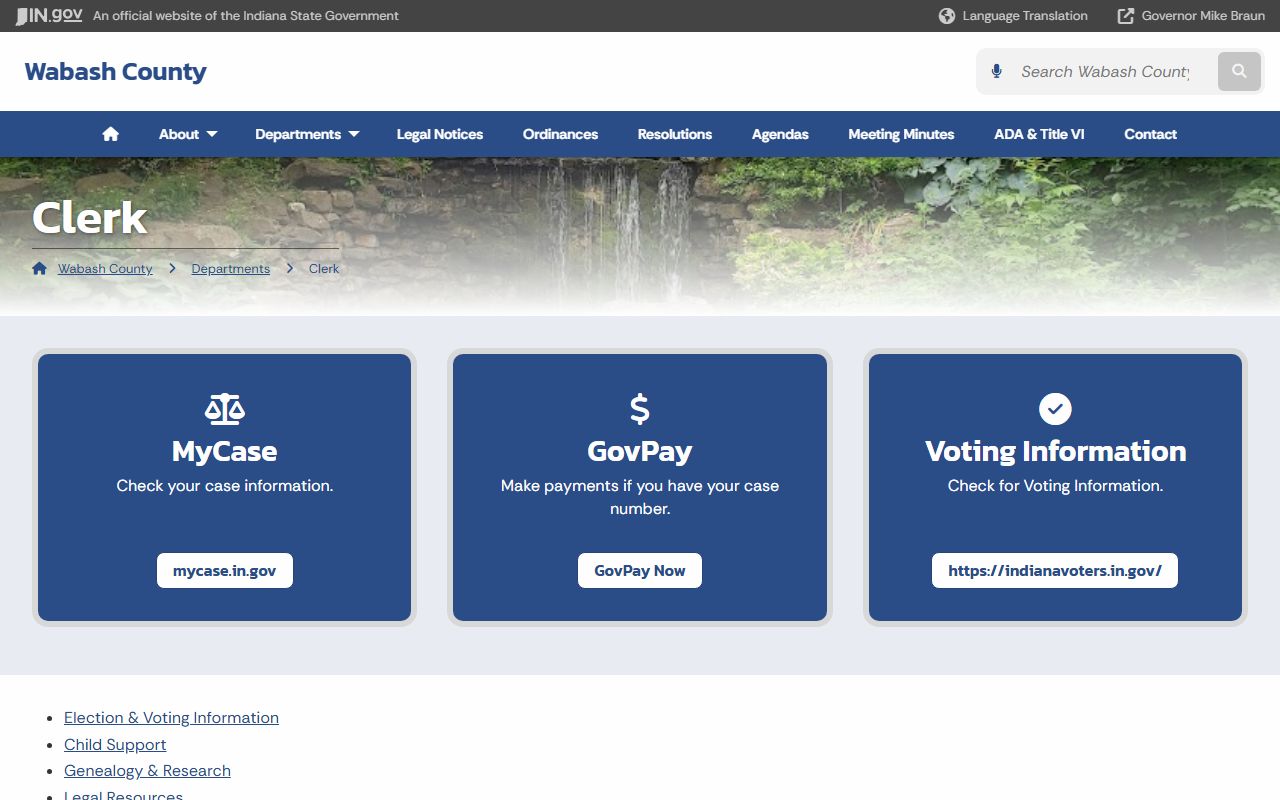
The Clerk's page is the local source for official records when online MyCase information is incomplete or a certified copy is needed.
Wabash County Public Access Rules
Indiana APRA governs public records held by public agencies, including law-enforcement records, while court rules and court offices govern official court files. IC 5-14-3-5 covers certain arrest and jailed-person information. IC 5-14-3-4 lists exemptions and confidential records, including investigatory records. MyCase is public access, but the court or Clerk remains the source for official records.
Note: Juvenile, sealed, expunged, confidential, security-sensitive, and investigatory materials may be limited even when a related adult criminal case is public.
Public Record Search
Sponsored Results